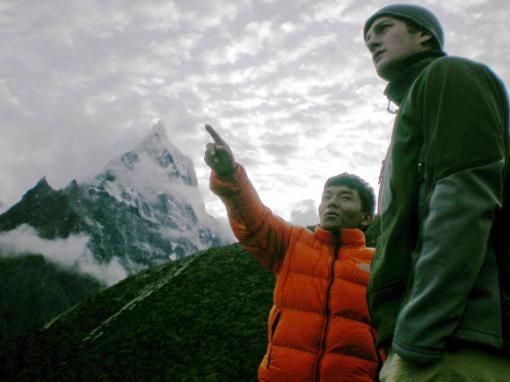
I just got back from a trek to the Base Camp of Mt. Everest. Our group had one guide named Pema Sherpa and three porters.
Of course I’d heard about the Sherpas of the Himalayas, but this was the first time I’d ever spent time with them. Over the next two weeks they were part of our group; hiking, sitting beside the fire at night, playing cards, eating and sleeping. I learned a good deal about them and the other Sherpas who were constantly making their way up the mountain.
They are one of the most impressive groups of people I have met in my life.
As we hiked, we shared the trail with other Sherpas who were transporting food and supplies up the mountain to the various villages and outposts. The only way to get supplies into these remote, mountainous locations is by foot. Goods are loaded into woven baskets, which are carried by means of a large flat strap placed over the top of the head in lieu of the traditional shoulder straps.
We would stand in awe as men trotted past us on the trail carrying more than their own bodyweight in rice, strapped to their heads.
After six years in military special operations, I respect what it takes to move with a fully loaded ruck. In one program, I spent almost four straight months with a 58 pound sandbag in my rucksack along with the rest of my gear. It was crushing.
After watching a small group of Sherpas go by-one of them with a large metal door on his back-I asked Pema how much a Sherpa would carry. He thought about it a moment.
“The strongest Sherpa… maybe 120, 130 kilos.”
I did the math in my head. Slowly. “Pema… That’s 285 pounds.”
“Yes. Porters are paid by kilo. More carry weight is more money for family.”
The Sherpas in our group each carried around 90 pounds and lead the way on the trail. Our packs at this point were stripped down and weighed comparably little because the Sherpas carried most of the heaviest gear.
Sange Sherpa, AKA Speedy Sherpa, usually lead the group on the trail. Even with my tiny pack vs. his giant pack, I sometimes had to jog to keep up.
Sange, two others and I finished a long hike one day and at the lodge learned that someone in our group had gotten sick and was staying with Pema at a lodge not far from where we had started that day. We had been hiking all day and were exhausted.
Sange and another Sherpa from our group conferred and then turned to me and asked to borrow my headlamp.
Without another word and without food, water or a moment’s rest, they turned and started jogging back up the fifteen-mile trail we had just spent all day descending. If the girl’s health deteriorated overnight, they would be there to carry her down on their shoulders in order to get her to a location that had Medevac access.
A few studies have been done on the Sherpa people. They have been found to have higher than average ventilatory capacities and responses, which allow them to adapt especially well to high-altitude exertion. The thing is though, that these differences aren’t all that substantial.
At about 15,000 feet, we came across a group of British trekkers with a pulse oximeter. We used it to measure heart rate and blood-oxygen saturation levels of members of our group. The highest O2 saturation level was 90%. The lowest was 82%. The highest resting heart rate was 98 bpm. The lowest was 78. Then I tested Pema.
I had been expecting something astounding. Perhaps near perfect oxygen saturation and a rock-bottom heart rate. The man has summited the highest mountain in the world on more than one occasion.
Pema’s blood oxygen level was 84%. Same as mine. His heart rate was 86. About five beats below mine.
Pema is human. His body was being affected by the altitude just the same as ours along at least two testable parameters.
How does one explain the incredible physical abilities of the Sherpas?
I think that the answer is simple. They represent a particular aspect of human potential, fully realized.
The Sherpa culture creates an entirely different mindset than that of most of the rest of the world. The limits that we think exist as far as how high one can climb, with how heavy a load, with how little food; do not exist for them. Their world is different.
I have met free-divers who could take a breath of air and dive down deep enough to sneak up on SCUBA divers. I once had a roommate who would run from San Diego to Los Angeles on the weekend because he was bored. I worked briefly with a guy who could do over one hundred pull-ups in one shot.
The limits of human potential are beyond anything that you or I can readily perceive. The walls that we trap ourselves within are of our own creation. Illusions. They’re all illusions.
What limits are holding you back? Do they really exist? Can you break them? What would happen if you did? Take some time to ask yourself those questions. Write them down somewhere and come back to them. You may be afraid of the answer.